Ancillary Justice

51D-qGmHGgL._SX323_BO1,204,203,200_
image from amazon page

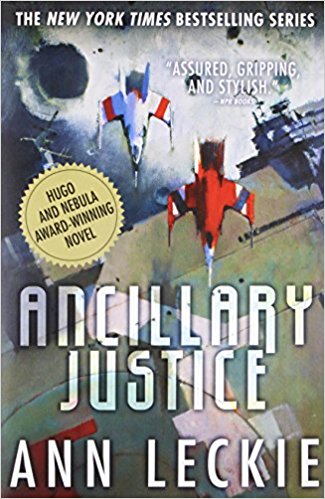
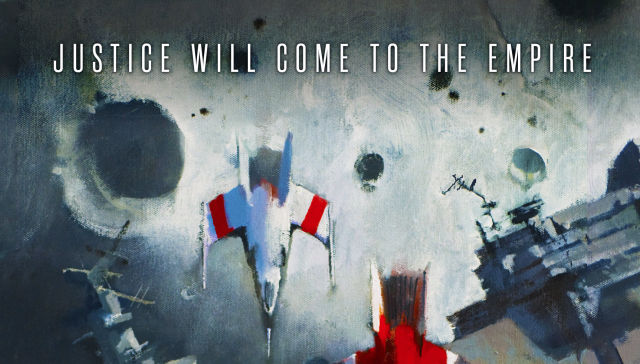
Ancillary Justice, by Ann Leckie, should not be described as another distant future space opera, although it operates within all of these categories. The book hurls the reader into distant space, where the Radche is an enormous, overwhelming empire, overseen by Anaander Mianaai and her multitudinous bodies are the Lord of the Radch. The reader begins to piece together the connections between two plot threads. In one, the mysterious stranger Breq, comes across a Radchaai officer, Seivarden, she had known a thousand years in the past, now slowly dying in the snow of a winter planet. Breq shows mercy to the young officer, and continues her pursuit of a legendary weapon. In the other thread, Breq is not using the name Breq, but is the collective consciousness of the spaceship Justice of Toren, as well as all its ancillaries.

These ancillaries are the idea that was so hard for me to wrap my head around at first, along with the collective consciousness behind them. Ancillaries of the Imperial Radch are, in fact, bodies killed during Radchaai annexations, then revived as automaton soldiers. Therefore, the ship Justice of Toren is aware not only of every individual within the ship (and the data from all their implants), but also is each of the ancillary units. The notable unit of ancillaries is in fact stationed on the planet Justice of Toren is orbiting during its annexation, Shis’urna, and are serving under the orders of Lieutenant Awn, who is trying to unravel a plot of sabotage in an occupied city before it spirals out of control. Justice of Toren, and its ancillary unit One Esk, seems quite preoccupied with this officer, and the way Leckie lays out this fondness and concern on the part of what is essentially an AI is masterfully done. This is all happening while the reader is still grasping how Justice of Toren thinks. One memorable moment in particular is when One Esk is standing near the lieutenant, and sees herself also outside of the temple in several locations around the lower city courtyard.

Slowly, the two threads of the plot reach towards one another, and we learn how the peculiar habit specific to Justice of Toren One Esk had – of collecting and singing various songs from all its visited planets and peoples and thousands of years – becomes crucially significant, and how this enormous starship AI was reduced to a single, frail ancillary body who took the name Breq. What happens if the connection between each of the ancillary units and the ship are cut off? What happens if the Lord of the Radch sneaks onboard, with secret orders for the ship that supersede even the ship’s captain? What happens to a ship if it grows fond of an officer, or even its captain, who then dies? What does it mean for a starship to lose its mind?
Leckie_AncillaryJustice_long-640x364
image from this Ars Technica review

A couple other notes. I found the function of the Imperial Radch fascinating, as I did the Empire’s approach of assimilating all religions, and how Breq came to embrace them. I want to learn more about how that works and how it plays out across the sprawling Empire. I want to learn more about the ships, the Justices, the Swords, and the Mercies. Also quite well done, in my view, was how Leckie built a galaxy-spanning empire of people without a gender binary. I have to admit that I’m primed for this kind of society, being a teacher who uses Ursula Le Guin’s The Left Hand of Darkness annually to discuss gender – and to be honest I think Ancillary Justice does a far more satisfying job of carrying out the concept. The decision to use the female pronoun for all Radchaai citizens is certainly not perfect, but I think it was the best possible approach. Carrying the idea home is how Breq can never figure out pronouns when on a planet with a gender binary, the flipping of pronouns by others when regarding the officer Seivarden, and both of their obvious relief upon returning to a Radchaai region, when the binary no longer presents a puzzle. All of that works, it takes some time and effort but creates a non-binary society better than Le Guin did, even lacking a biological interlude, and it does it in a way that really doesn’t obstruct the plot. Once the reader figures out who is who (which is further complicated by these individual consciousnesses in collective bodies), everything else starts to click into place (in this io9 piece from a longer interview, Leckie talks about how she received early criticism for the pronouns, but was steadfast in her decision). Overall, I found this a wonderful book, and eagerly look forward to reading the second book of the trilogy.


FLCL

I always have difficulty in answering questions like “what’s your favorite book / band / TV show?” I don’t really have consistent favorites, just common answers that I return to, and there have definitely been times where I answered a question about a favorite band that I really didn’t mean, and just used because its something I’d said before.

I think my favorites are constantly shifting, and its really dependent on what has been recent for me, in addition to the fact that comparison among such big genres is nigh impossible. Whenever I try to pick a favorite, then, I usually just preface my answer by saying that this is my favorite right now.

However, the brief anime series FLCL (pronounced Fooly Cooly) might very well stand up as one of my all-time favorites for a television show. Its a show I’ve habitually returned to over the years, despite being a person who almost never rewatches shows.

FLCL_image.jpgFLCL_(Fooly_Cooly)_anime_logo.svg.png

From the very first scene (“he who conquers the left side conquers the world, Chief”), I got the sense that this would be a new favorite show of mine. The show immediately and deftly works together a small-town, slice of life atmosphere while simultaneously setting itself up as a cheeky, never-serious and over-the-top series. The series somehow manages to have both deep, complex characters and a wild, unpredictable chain of events.

FLCLcharas.jpg

“Nothing amazing happens here. Everything is ordinary.” These small moments of calm and reflection (in that case as the camera pans upwards past a massive building in the shape of a clothing iron), are tucked neatly into Japanese anime industry in-jokes, raucous action sequences, and the dramatic shifts in style. The moments of quiet, though, are the real reason this show is my favorite. A second where Naota lays on his bed and listens to a plane fly over, the school announcements coming on in the background of students talking, or a long, tense moment of silence after a yelled outburst. This show is a master of capturing “real” moments of everyday life, and I find it difficult to think of other shows that have the same level of detail.

The show was produced by the FLCL Production Committee, a supergroup of sorts from the anime industry. The director, Kazuya Tsurumaki, said in an interview that with FLCL he tried to “break the rules” of an anime show. One way to do this was to mimic a promotional or commercial style, creating a slapdash, short but densely packed series of episodes. Another fairly unique production choice was to bring in a Japanese alternative rock back, The Pillows, for the soundtrack.

FLCL has earned widespread acclaim, and several reviews really resonated with my own feelings of the show. “FLCL is something that allowed those involved to try a wide variety of styles and techniques and does come off as quite experimental. But nearly everything worked in their favor and you end up with three hours of nearly break neck speed action, comedy and commentary on modern life.” says Chris Beveridge of Mania (quote from Wikipedia as the original website seems to be lost).

One of the more comprehensive and well-written reviews comes from IGN, where Davis Smith writes, “Logic dictates that FLCL should be an undisciplined and unaffecting mess, given all the insanity that its creators are attempting to weld into a functioning whole. Yet while it’s hard to explain exactly why, it works. It entertains me. At times, it makes me laugh; at times, it makes me a little misty-eyed; at times, it makes me want to scream and howl and light things on fire and break windows with baseball bats and yes, maybe even buy a Vespa. That’s the kind of success that you just can’t argue with.”

1200
image from Gainax through this AVClub review

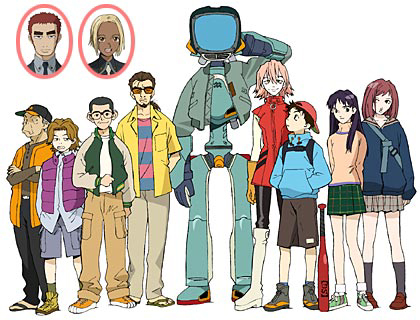
One of my favorite characters is the robot, who is known by a variety of names, like “TV Boy” by Naota’s father, or Cantido, the Lord of the Black Flames by Mamimi. I love how this character is just deeply unknowable. Most often referred to as Canti, he becomes a critically important character in the plot, but as that happens he’s used for a variety of tasks by the rest of the characters – from retrieving drinks and adult magazines to recording TV shows, to playing baseball or becoming a powerful host for characters in mecha combat. Canti is a robot who’s been anthropomorphized, feeling shame at having the back of his head cracked, mysteriously eating curry, or displaying compassion and kindness even to those who try to destroy him.

Now, 16 years later from the original 2000-2001 production of the show, FLCL will have seasons 2 and 3 released in late 2017-2018. I was blown away when first hearing about that, and I’m happy to learn more details about the new seasons, especially the fact that The Pillows will once again be providing the soundtrack. I will have to make an effort not to raise my expectations too high, but a return to the world of FLCL is certainly a trip to look forwards to.


a note

This is the first post. Being a new blog called ‘the final bell,’ a lengthy first post doesn’t seem to make much sense.

A note of background, I suppose. This will be a blog of book and media reviews and analysis, mixed in with personal blogs and posts on subjects of interest. The blog name and title come from the book Sabriel, by Garth Nix.